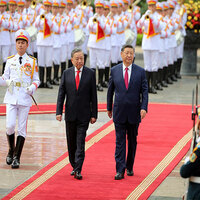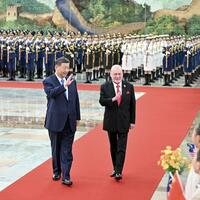


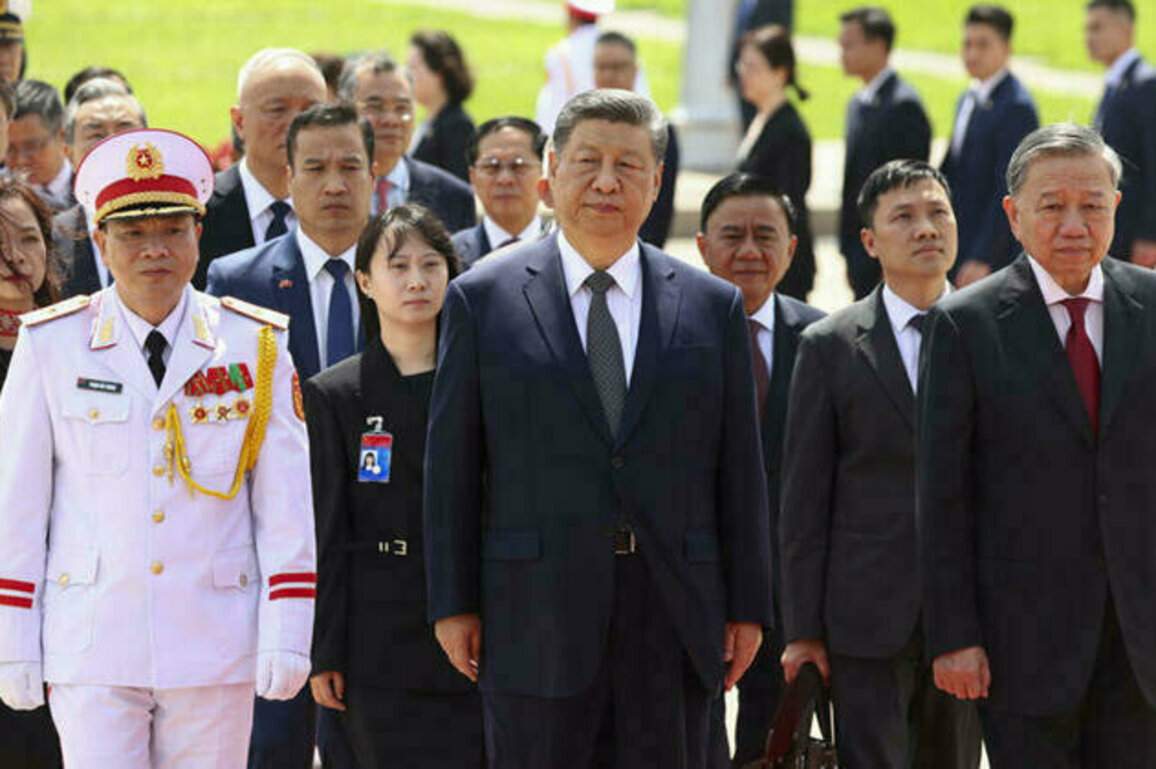
Chinese President Xi Jinping marked the last day of his two-day trip to Vietnam with a visit to the mausoleum of late revolutionary leader Ho Chi Minh in Hanoi. His US counterpart Donald Trump told reporters late Monday that Hanoi and Beijing's meeting was built around trying to find ways to "screw" the US.
China's PresidentXi Jinpingpaid tribute toVietnam's late revolutionary leader Ho Chi Minh on Tuesday, his last day of a trip to Hanoi that PresidentDonald Trumpsaid was aiming to "screw" the United States.
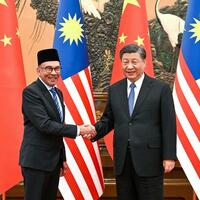
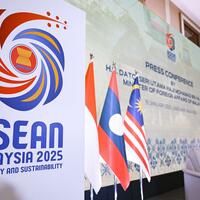
Xi is in Vietnam as part of a Southeast Asia tour that will includeMalaysiaandCambodia, with Beijing trying to position itself asa stable alternative to Trumpas leaders confront UStariffs.
The Chinese leader called on his country and Vietnam Monday to "oppose unilateral bullying and uphold the stability of the global free trade system", according to Beijing's state media.
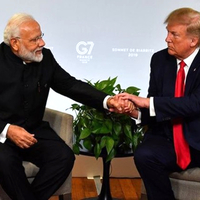
Hours later, Trump told reporters at the White House that their meeting was aimed at hurting the United States.
"I don't blame China. I don't blame Vietnam. I don't. I see they're meeting today, and that's wonderful," he said.
"That's a lovely meeting ... like trying to figure out, how do we screw the United States of America."
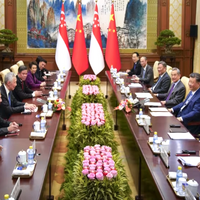
China and Vietnamsigned 45 cooperation agreementson Monday, including on supply chains,artificial intelligence, joint maritime patrols and railway development.
Xi said a meeting with Vietnam's top leader To Lam on Monday that their countries were "standing at the turning point of history ... and should move forward with joint hands".
Lam said after the talks that the two leaders "reached many important and comprehensive common perceptions", according to Vietnam News Agency.
Rail links
On the final day of his visit, Xi laid a red wreath emblazoned with his name and the words "Long live Vietnam's great leader President Ho Chi Minh" at the late leader's mausoleum in central Hanoi.
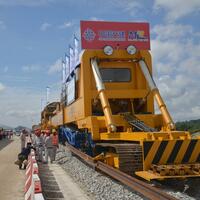
He is also due to attend the launch of the Vietnam-China Railway Cooperation, which will help manage an $8-billion rail project to link Vietnam's largest northern port city to the border with China.
Mistrust between the two countries, which fought a brief border war in the late 1970s, has long hampered progress on rail links, but in recent months economic considerations appear to have prevailed over security concerns.
The two neighbours have long been discussing plans to upgrade two railways that were built by the French more than a century ago, and develop a third direct link along their adjoining coast.
Beijing and Hanoi have now agreed to conduct feasibility studies for two new rail lines, according to one of the agreements reviewed by Reuters.
Lam said on Monday the building of the three railways was "the highest priority" in infrastructure cooperation between the two countries and encouraged China to offer concessional loans.
They agreed China will carry out feasibility studies for two of the planned rail links, at a cost of 9.95 million yuan ($1.36 million), according to the two-page cooperation document, dated April 14, seen by Reuters.
A third railway linking Vietnam's northern coast to Kunming in China will begin construction this year, the Vietnamese parliament said in February, estimating the section through Vietnam would cost $8.3 billion and be partly covered with loans from China.
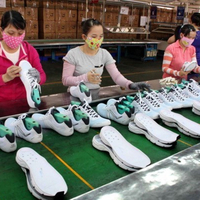
Read moreStunned by Trumps tariffs, world clothing suppliers are preparing to squeeze workers
Xi's trip comes almost two weeks after the United States the biggest export market for Vietnam,a manufacturing powerhouse, in the first three months of the year imposed a 46 percent levy on Vietnamese goods as part of a global tariff blitz.
Although the US tariffs on Vietnam and most other countries have been paused, China still faces enormous levies and is seeking to tighten regional trade ties and offset their impact during Xi's first overseas trip of the year.
Xi will head to Malaysia later Tuesday and then Cambodia on a tour that "bears major importance" for the broader region, Beijing has said.
Xi earlier urged Vietnam and China to "resolutely safeguard the multilateral trading system, stable global industrial and supply chains, and open and cooperative international environment".
He also reiterated Beijing's line that a "trade warand tariff war will produce no winner, and protectionism will lead nowhere" in an article published on Monday in Vietnam's major state-run Nhan Dan newspaper.
China and Vietnam, both ruled by communist parties, already share a "comprehensive strategic partnership", Hanoi's highest diplomatic status.
Vietnam has long pursued a "bamboo diplomacy" approach striving to stay on good terms with both China and the United States.
The two countries have close economic ties, but Hanoi shares US concerns about Beijing's increasing assertiveness in the contestedSouth China Sea.
(FRANCE 24 with AFP and Reuters)
Originally published on France24